Washed in the Word Part 7 – Inspecting Scripture

After surveying a book of the Bible you should now have a good idea of the themes or topics written about in that book. With these topics in mind and the summaries you have written as a foundation for the context you will need you are ready to look more deeply at each chapter. The things to look for and symbols you can use expands at this point to include all those in the symbol guide pictured here. 

Here we will go over the basic method for inspection and interpretation, understanding what you read, and general things to look for. During the survey we limited what we looked for and the questions we asked but here the field is wide open. Look for every category, ask whatever question comes to mind and think deeply. There are more specific things to look for and questions you can ask based upon the genre and literary devices which deserve their own chapters.  We will address those later down the road. 

The Inspection Journal

Rather than dive right into what to look for and the deeper methods of observation and interrogation let us start with the tools and how to use them. During the survey you used some symbols, colored pens and marking guides along with a few basic questions and recorded the key words and summaries in a Survey worksheet. Now you will broaden your marking and observations in the bible and instead of a worksheet it will be a bit freer form using a Journal similar to what Johnathan Edwards called a Miscellanies Journal. If you have a wide margin bible, you could use that space for a journal but even in wide margin bibles space is still limited. 

The 18th Century Pastor and Theologian, Johnathan Edwards, would take a journal and label it with a letter starting with M for Miscellanies. He would reserve the first few pages for an index and then he would date his first entry and label it with M0001 and the Bible reference he was studying, say Joshua 1. In the margins of his Bible for Joshua 1 he would write M0001 to cross reference with the journal and then record his thoughts and questions about the passages as he read it in the journal. He would then list the journal pages along with the label, reference, and theme in the index. With this method he could write as much as he wanted and years later if he were rereading the passage, he could add to the notes with a new journal just referencing it with its letter and sequence number in the Bible’s margin. 

The Inspect process will use this same tool. For a journal I would recommend an A5 (6×8) dotted or lined journal which are easy to find. After I reached 50 writing and reading smaller text became increasingly difficult, so I started using either a letter/A4 size or B5 (7×10) dotted or lined journal. A dotted journal provides free space and guides if you like drawing diagrams or pictures; yes, draw away. As you look more deeply at a passage marking more significant or important words and drawing lines to see relationships you will then start asking questions and thinking about answers. Write these questions and answers and any other thoughts you may have in a journal. Do not feel as if you must answer every question that comes to mind. If some of your questions don’t seem to have answers write them in the journal anyway and leave some space after the question for a future answer. You may also want to use a colored sticky tab to mark the unanswered questions in the journal.  Look back and review your questions and as you move forward reading the Bible you may find answers to those questions at which point you can write the answer and cross reference it with different color ink to where you are in the Bible using that future entry’s label and reference where you find the answer and then toss out the tab.

If you believe God is saying something significant to us, His People, record it as a thesis statement and use a sticky tab to mark it for further verification. You would then take this idea or hypothesis and reexamine them during the examination phase.

Interrogating the Bible Passage

Let’s get back to asking questions. During the survey questions were limited to finding the setting. Now ask any question that comes to mind. To start let’s revisit the five Ws and a H. Asking where and when is what we started with in the survey but is there anything more we could ask about location and time? If the bible is saying something is happening at a certain time or place is it where or when it should happen? An example is Deuteronomy 6 and 11 where God tells the people to talk about His words at home when they sit down, when they rise up and when they travel.

We talked about asking who are the characters involved and identifying God’s involvement. Who is the author and who is it written to or about? The Bible is God’s word written for God’s people but some words were for unbelievers, those that are not God’s people. In these cases the words used and the practices described will fall into that context and usually are ridiculed or contrasted with what is right. Having a clear picture of “who” becomes critical to understanding what God is saying.

Next what is being described or what is happening? Then the follow up question is why. Why did this happen? Why is God calling attention to this? When you are trying to find the reason or cause for something be prepared to ask why more than once. Why did “A” happen? Well because “B” happened. Why did “B” happen? Well because “C” circumstances were encountered. Why were “C” circumstances encountered? Well because “D” decisions were made. You may have to ask why up to five times to get to the root of the matter. 

Finally, ask how. How did they get to this point? How did they do that and why? How important is this or what is its significance?  Is the Bible saying this is how things should be done or is it just how something was done? If it is how things should be done usually God will be involved either showing his approval or giving a command. Otherwise, God will show his disapproval. If God’s point of view is not clear then be careful not to draw a conclusion or pass judgements when God Himself doesn’t do so.

Coming to an Understanding

The answers to the questions you ask form the basis for your understanding of what God wants to say. The practice of understanding the bible is called interpretation. The methods used to understand the Bible are called hermeneutics. As you are asking questions and making observations there are some guidelines you should keep in mind before you draw any conclusions and as you answer questions.

  • It is not advisable to develop a guiding principle or draw a conclusion based on a single obscure verse in the Bible. An example would be Mark 16:18 “they will pick up serpents, and if they drink any deadly poison, it shall not hurt them;”. Another verse is 1 Corinthians 15:29 which says, “what will they do those who are baptized for the dead”. Baptism for the dead is obscure and could have several possible meanings but there are no available ancient manuscripts that help explain this verse.
  • The Bible itself is its best interpreter. As the inspired word of God the bible is consistent and coherent. If some passage doesn’t seem to make sense, is unclear or has many possible meanings, especially if they do not align, the correct meaning is the one supported by other passages in the Bible.
  • Understand historical accounts in the Bible by the teachings in the Bible. For example the letters written by Paul and the other Apostles provide explanations and teachings for the church. That should be used to understand the history recorded in the gospels and Acts.
  • What someone does in the Bible should not necessarily be considered prescriptive; the way we should always do things. Unless it is specifically commanded something done may just be the way someone did something and not necessarily the way we should do something. For example; just because Gideon requested a specific sign from God does not mean that is how we should approach God for direction.
  • It is not advisable to pass judgement on what God’s anointed followers do in a passage of the Bible unless God Himself does so either in the passage or somewhere else explicitly in the Bible. If God judges someone’s actions in the Bible do not add to it. Something may sound wrong but could just be from our own modern sensibilities. For example we tend to look down on arranged marriages but most in the Bible were arranged including the very first marriage between Adam and Eve, arranged by God. 
  • Do not let man’s conclusions, methods or principles dictate what the Bible must mean. If you find yourself saying, “Well, the Bible can’t mean that!” be careful that you are not lifting an idea or theology, a system of man above the Bible.
  • If God tells a specific group or type of person to do something that doesn’t mean the scope is limited to that group or type of person. Just because the letters to Timothy were written to a pastor doesn’t mean we don’t need to read them nor that nothing in them applies to us who are not pastors. Just because God tells fathers to do something with their children doesn’t mean mothers are not to do it as well.
Washed in the Word Part 6 – How to Survey a Book of the Bible

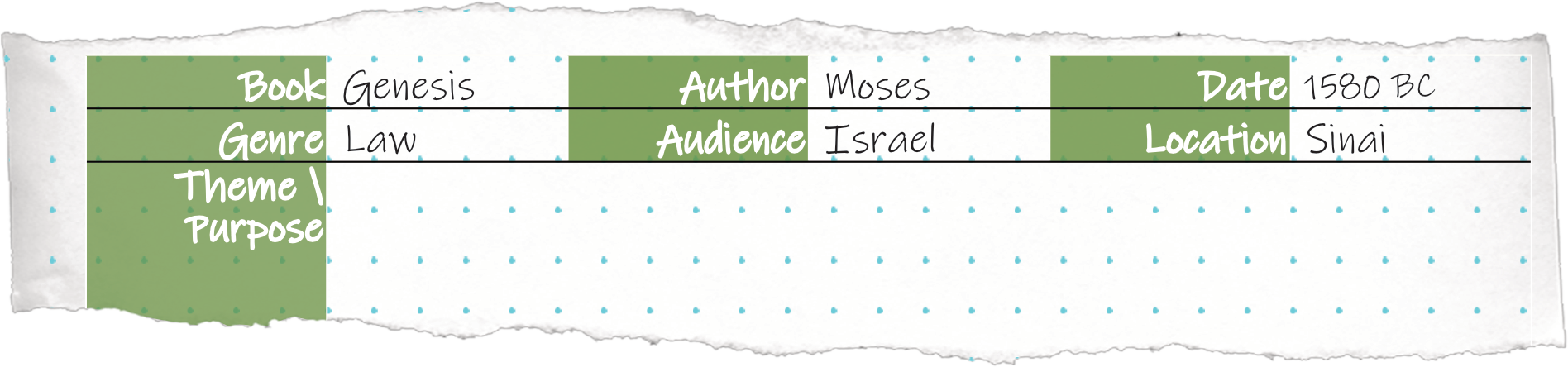
The first goal of the Washed in the Word R.INS.E study method is to Read the book of the bible you are studying chapter by chapter trying to grasp the big picture so that you have a high-level idea of the topics of each chapter. This forms the context that you need to have before you can read any passage in that book of the Bible more deeply. In the survey worksheet the heading of the first page for each book has a form for recording the book name, genre, author, audience, date and location of writing. This is followed by a block section where after reading the book you record its theme and purpose and any other notes or thoughts.

Some of this basic information you may be able to find in each book as you read it otherwise a good study bible or commentary will have this information. To make it easier, at the end of this section there will be two tables, one for the Old Testament and one for the New with this information.

Surveying the Text

Identify

To do a survey you will be concentrating on the setting and keywords which you will mark in brown and God marked in purple. Start by looking for and circling repeated words and their synonyms.  If they match one of the categories depicted in the earlier section, then circle them in that categories color. Why do you start by looking for repeated words? With anything written the author has some ideas or points he wants to communicate to the reader. The terms that describe these points will be repeated as they are exponded upon or will be stressed using repetition. Therefore to grasp the major topics one needs to look for repeated terms and these form the basis for the context of what is written.

As you identify key repeated words make note of the genre if it differs from the book’s general genre. Books of law may also have history and poetry. Identify people, places and things that make up the setting and key events or commands and mark these following the symbols guide below. These might be obvious, but they might not stand out. At this point you can start using inquiry or some simple questions to help identify elements of the setting and circumstances. 

Inquire

In English classes you should have run into the five Ws and a H. While surveying and later when you inspect the text you will need to start asking who, what, when, where, why, and how. While surveying the level of questioning doesn’t need to be as probing as when you are rereading the text during the Inspection phase and you will limit yourself to specific questions focusing on the setting and keywords to just gain a basic understanding of the topic that is being addressed in the chapter. 

Start by asking who are the main characters or groups of characters and are they a protagonist or antagonist? What does God do or what does He command or promise? Marking what he does with a purple double underline and God’s promises with a purple arch and His commands with a green exclamation point and underline. What are the main events? Mark antagonists and protagonists with a brown underline ending in an A or P respectively. If it is a king or kingdom draw a blue crown at the beginning. Mark references to God with a purple triangle or angel of the Lord with a red cross. But only mark these when God is actively at work or responding. If the chapter is just talking about God such as saying “we have sinned against God” then these references do not need to be marked. You only want to call attention to God, Jesus or the Holy Spirit when they are an active character in the chapter so you can see when God is responding. The goal here and and more so during the Inspection phase is to grasp what His feelings are about the circumstances recorded.

Then ask where is this happening or where is the author seeing what he is writing? When is this happening? Underline and mark the location with a blue at sign @ and times with a blue circle with clock hands (/). If the author is writing from a particular vantage point rather than use an at sign start with a semi-encircled v into an (V underline. For example when Moses is describing the creation of the world in Genesis 1 where is he? He is with “(V the Spirit hovering over the waters“. 

The vantage point and use of phenomenal language can be key to understanding what the bible is saying. Phenomenal language is the use of words to describe what you see or feel happening from the perspective of your senses and from your vantage point. We use this every day when we say “the sun rose” or “the sun set”. The sun doesn’t really go up or rise nor does it go down or set. When Moses describes the sky as a firmament he isn’t saying it is a solid dome, he is saying it looks like a dome. If you accept that it must be a dome then you run into the problem of a clash with reality that is not necessary at all. While the bible is not a science text book it does describe things that actually happened and that exist. Whatever may be described more precisely or scientifically should be able to match what the author describes if he were to experience it, the bible does not make mistakes. 

Digest / Summarize

Since this is a survey you don’t want to spend much time asking how and why. If an explanation of how or why is apparent take note of it but we will spend time on this during the inspection phase. After you have read the chapter and marked the obvious keywords and setting record the keywords in the keyword’s column in the survey form and in the margin of your bible. Then write a short one or two sentence summary in the middle summary section of the form. If the genre is different from that of the book record that in parenthesis. 

These summaries and the worksheets will become a reference in the future as you inspect and re-examine a passage in the Bible. It will form the context that limits or qualifies what may be understood. Finally, they will help you better remember what you have read and will develop Biblical Intelligence.

“Perhaps the best test of a man’s intelligence is the capacity for making a summary.” – Lyton Stachey
Then the best exercise to develop biblical intelligence is to practice making summaries.

Roll Up into a Breakdown

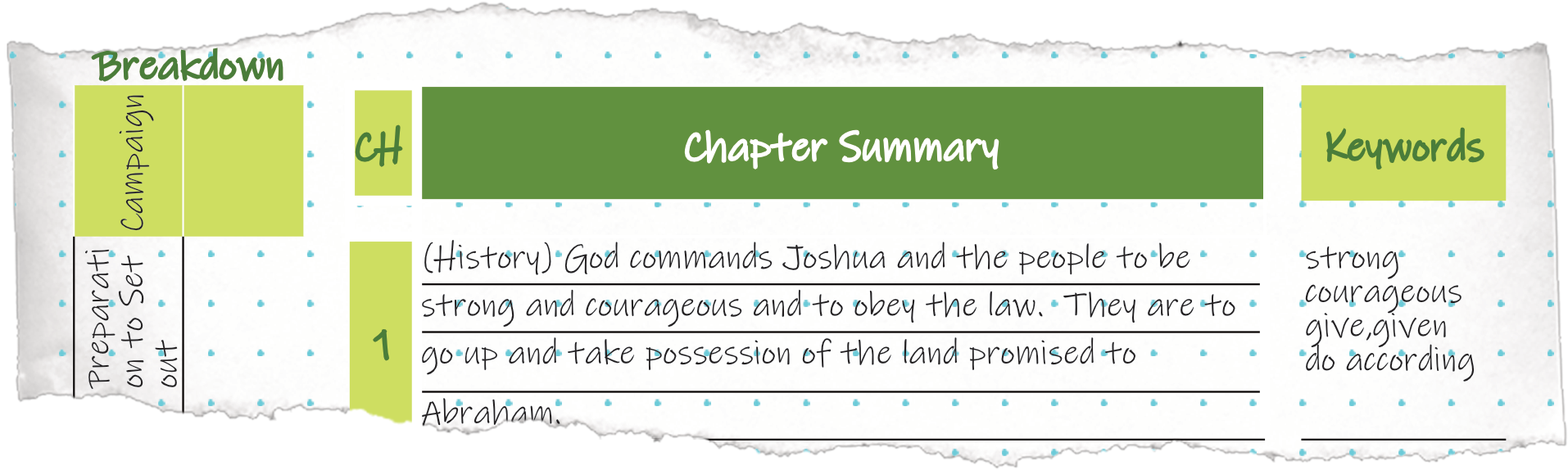
In the Bible survey worksheet you have been recording the keywords and summaries. Now it’s time to pull it all together. Consider the keywords column from each chapter and the categories they might fall into. Can you group the keywords in any way? Use the breakdown columns to group the chapters and their keywords into categories. You are rolling up the chapters’ settings and key words into main points of an outline which becomes the breakdown of the book. 

You are looking for relationships between chapters and you will need to do this as part of an end of book review but if you notice a change or turning point or transition while reading don’t hesitate to make note of it using a pencil in the breakdown column so you don’t forget it. To use the breakdown columns you will want to turn the page horizontal and draw lines between these changes you see in categories and then write a short title for that break or segment. Some categories or ways of grouping keywords and circumstances of the setting include:

  • Composition or Literary Devices
    • Pivotal Points / Turning Points
    • Progression and Climax
    • Radiation
  • Others
    • Time / Place / Vantage Point
    • Reigns
    • Topics
    • Doctrines
    • Events / Tasks
    • Signs
    • Goals / Objectives

Finally, in the heading block of the worksheet write a theme and purpose for the entire book. The theme can be thought of as if someone were to ask you “write me a title for that book”. Next write down why you think the book was written and any other notes you feel may be helpful. Now you have completed your survey of the book. You will want to keep these surveys for future reference whenever you come back to study a passage in that particular book of the Bible.

Old Testament Books – Author, Date, Location and Genre

New Testament Books – Author, Date, Location and Genre

Washed in the Word Part 5 – Method Overview

The Washed in the Word method of Bible Study is made up of three phases or degrees of study called R.INS.E, followed by Reflection and Response.  During each phase you will use methods of observation and interrogation of the Bible passages you are studying to progress to ever deeper levels of understanding. The R.INS.E acronym stands for Read, Inspect and Examine.

R.INS.E – Reflect – Respond Method of Bible Study Diagram

First you Read a book of the Bible chapter by chapter with the goal of grasping the big picture. This big picture should be captured in survey journal worksheets with lists of keywords and summaries for each chapter that then become the context for the next phase of study, Inspection. While you are reading and during inspection you will use colored pens to mark keywords, circumstances and God’s responses through which He reveals Himself to His people. The colors you use for marking should use consistent categories and symbols. The category color guide below is a suggestion of colors and their categories for your consideration. You can use these or come up with your own, or just start with these and then when you get a new journaling Bible you can always consider coming up with your own categories.

During inspection you ask deeper questions and look for other concepts and connecting words that show the relationships between statements. The questions you have and answers you find should be recorded in a journal called a Miscellanies (invented by Johnathan Edwards). A Miscellanies journal is designated with a letter code and then each entry with that code and a four digit sequence number and the bible reference being studied. The code and sequence number are then written in the bible margin of the passage being studied. This method allows you to write much more about a passage than you would be able to in the margins of any Bible.  A dotted journal even allows you to draw diagrams and pictures to help visualize what a passage is saying. 

The third phase or degree is Examination where you use concordances to look for what else the bible has to say on the topics and keywords realted to the passage you have inspected. After Inspection you should have used methods of interpretation and reached a level of understanding of the passage. During Examination you write down what you understand and compare it to the other similar passages found in cross reference resources using the cross reference worksheets to evaluate your understanding. 

After both Inspection and Examination you should spend time reflecting upon what you have observed and understood from the passage. Based on what your have understood and reflection on your own life you may find verses you should memorise or things you should do. You will capture the Bible verses to memorize and the things you need to do in verse and task kanbans. These give you a set of things to work on that will become your response to what God’s spirit has revealed in scripture that you should do.

23 Because if anyone is a hearer of the word and not a doer, he is like someone looking at his own face in a mirror. 24 For he looks at himself, goes away, and immediately forgets what kind of person he was. 25 But the one who looks intently into the perfect law of freedom and perseveres in it, and is not a forgetful hearer but a doer who works—this person will be blessed in what he does.

James 1:23-25

Washed in the Word Part 4 – Bible Study Tools

Now that you have set out to study God’s word there are some things you will need and some things you may want to consider adding to your tools for studying the Bible. The first and most obvious would be a Bible. But which Bible is the best choice? As mentioned previously there are many translations. The Bible was written in Hebrew and Greek. What you may not know is that not only are the words different in another language but the order of words may also be different. For example, not only is Hebrew written from right to left but while English sentences have the order subject-verb-object, SVO, in Hebrew the word order in a sentence is subject-object-verb, SOV, and it only switches to subject-verb-object in Hebrew poetry. Further adjectives and adverbs do not precede the noun or verb as in English but come after them. Other differences would be idioms or sayings. In Hebrew they would say “it doesn’t touch me” but in English we would say “It doesn’t ring a bell”. So, when a translator sits down to translate the Bible from its original language, they have a lot to consider communicating the intended meaning. 

Choosing a Good Translation

There are three methods translators use: formal equivalence, dynamic equivalence or paraphrase.

  • Formal equivalent translations have the goal of capturing the broadest meaning of the original language and try to use a single word in English whose possible meanings are as close to that of each word in the original language and then adjust the word order for English and where necessary reword sayings so that we can understand them. The words chosen will often be more academic or formal English words since the goal is the broadest sense of meaning. 
  • The dynamic equivalent focuses more on the meaning and spirit of the original text, rather than rigidly adhering to its structure and form. There are two types of dynamic equivalents. 
    • The Functional equivalent will approach each phrase constructing a phrase in English choose the best word or words leaning more toward the formal equivalent where possible. 
    • The Natural equivalent will look at the phrases that make up a single thought and craft a phrase to communicate the intended meaning using common language or the simplest wording possible. 
  • A paraphrase will take each sentence and write it in English with as many words and descriptions as the translator feels are necessary to communicate what they think the author was saying. 
LSB/NASB/NKJVGNTNLT
I will make you fishers of men.I will teach you to catch people.I will show you how to fish for people!
Matthew 4:19

What are the issues with these methods? A good example is Matthew 4:19 in the preceding table. The NLT translates “make” as “show you how” and this is easy to understand but it doesn’t capture the full meaning of the original language where as “teach” in the GNT includes “show you how” but also involves explanation and opportunities for practice and captures a broader meaning closer to the original. The word “make” however includes all these meanings but also captures the fact that God is in charge and actively working in the lives of the disciples. The simpler translation is missing a lot of meaning. All translations require the translator to understand to varying degrees what the original author was trying to say, which is interpretation. However, you must ask the question; at what point am I just listening to what someone thinks the Bible is saying instead of trying to understand what it is saying for myself? 

This is God’s word to us, and we should want to know what He is really saying. You should always start with reading the bible to get a basic idea of topics and a paraphrase or dynamic equivalent may be good enough but to really study the bible you will need a Natural or Formal Equivalent. The quadrant chart shows bible translations by their reading level and how close they are to the original meaning. The upper right quadrant are translations that have balance between being easy to read and being as close as possible to the original language.

Choosing a Good Bible Format

Once you choose a translation the Bible comes in many formats including digital online bibles as well as journaling, study, reference, and compact printed bibles. The Logos, Olive Tree and Blue Letter digital bibles have many resources and the ability to take notes, and highlight. Blue Letter ScriptureMark and Logos have some marking ability, but most digital bibles do not have the ability to draw lines and symbols. Print Bibles will either have two columns or a single column. Study bibles will have introductions, outlines, references to other similar bible verses either in between columns or in the gutter and commentaries at the bottom of each page. Study bibles have many tools that are useful to help understand the bible however most have so much information that the margins are too narrow to take notes. To study the bible and take notes one of the best formats is a single column bible with the references in the gutter and wide outside margins for notes such as the NKJV wide-margin reference bible, ESV/NASB Inductive Study Bible or Baker Illustrated CSB Study Bible.

Study BibleJournaling Reference Bible

Bible Marking and Journals

After selecting a bible to start journaling you will need to consider highlighters and marking pens. You will want to decide on a color code so that what you emphasize uses a color with a meaning behind it. Highlighters draw attention to verses that stand out or are significant in a chapter. The problem is many highlighters bleed through thin paper. The gel highlighters meant to solve this problem are more like crayons and do not bleed but leave a waxy film which prevents using pens for marking later and when they warm up in a car the pages tend to stick together. The best highlighters I have found are the Zebra Midliners.  

Still highlighters are limited to drawing attention to a verse. Using fine-liner or gel pens you can focus on individual words or phrases by circling, boxing, underlining, or even drawing symbols and lines may be drawn between these symbols to show relationships. Bible marking helps to show repeated words and to see relationships visually between words and phrases. I have found the best marking pens to be Charsoco or Micron MicroLine pens, followed by the Uni Style fit and the Zebra Sarasa Clip gel pens. The Uni Style fit and Zebra Clip pens also have customizable multi-pen options great for travel. 

While you can journal in your bible even the wide margin journaling bibles are limited with space. You can get A5 or Letter size binders to use custom forms like those in the resource section of this blog. The Survey forms are a good place to start and we will discuss these in upcoming articles. A page numbered dotted grid journal may be used to write further notes and even draw pictures. You can use a code for the journal such as M followed by numbers, 0001, which you write in your bible and then write at the top of the journal page and reference in a table of contents in the journal. With this method you can even journal using a bible with small margins and add multiple notes from multiple journals with different codes as you read God’s word over time. I suggested the first journal as M because this method was invented by Jonathan Edwards and he called it the Miscellanies journal method of bible study. In the next articles we will go over how to use these journals. Additionally you may want to add on some page marker tabs so you can mark questions you’ve recorded in your journal for which you may not know the answer but as you read on in the bible the answer may become apparent. If they are marked then you can come back to them.

Bible References – Commentaries, Concordances, & Dictionaries

Finally, there are many reference tools available that can help you on your journey. Many pastors and scholars have studied the bible and written down notes and their own thoughts about bible passages and these have been published in Commentaries. Many are available online in the Blue Letter Bible, and Bible Hub or you can buy copies in print. Some examples are the Moody Bible Commentary, Jamieson, Fausset & Brown, Matthew Henry, John MacArthur, the Archaeology Study Bible and Dr. J. Vernon McGee. These tools are good to check your understanding of a bible passage and to learn about the culture and people to whom the bible was written. 

Concordances such as the Open Bible Cross References, Treasury of Scripture Knowledge, Thomson’s Chain References and Strongs have lists of references, key words found in the bible or topics and give references to other similar verses in the Bible. This can help you find other passages in the bible that talk about the same topic and would be used to examine scripture with a cross reference study. Word study dictionaries such as Mounces or Vines allow you to look up an English word used in the Bible or if you have a word study bible with Strongs numbers you can look up the original Greek or Hebrew word using a code number and get its definitions and examples of how it used. These are good tools for doing word studies that can be found online at Blue Letter Lexical Resources or may be purchased in print format.

Washed in the Word – Part 1 Reverence

How you approach the Bible plays a crucial role in what impact it will have in your life. Many Christians hardly ever seriously spend time reading the Bible and others just look for a few words of encouragement. But God gave us His words in a book intending so much more. We have a book brought to us by the God who speaks and stars form while worlds come into existence. If you want to experience something transforming then you first must start with the right approach.

Most people don’t pick up a random book and just start reading it. You usually pick up a book because you are atleast either curious about its subject or author, but then you may not have high expectations. You are more likely to choose a book with excitement and great expectation if you admire the author and have an interest in the subject matter. Lets give an introduction here to what the Bible is to hopefully spur you on to love the Bible and seek to read it well.

Moses sat down in a tent they had setup outside the camp to meet with God (Ex 33). As on many occassions before (Ex 17,34 & Deut 17) he would write down on papyri what God would tell him to write. He had learned the Hieroglyphics and Hieratic script while growing up in Pharoah’s palace in Avaris. Also, someone had taken 22 of these characters and matched them up with the sounds of the language of his Hebrew people at some point over the 430 years they were staying in Egypt and he had learned this as well (Proto-Sinaitic). God had talked to other people before over the past millennia such as Job and Melchizedek and someone wrote down what Job had gone through and some other ancient texts seem to make similar statements to proverbs but this was the first time God was having a people he had chosen write down what He wanted them to for others to learn from for generations to come (Deut 6).

God had Moses and more than forty authors write sixty-six books over about 2000 years. Moses records how Adam and Eve fell to temptation from Satan in the form of a serpent and God told Eve (Gen 3) that her offspring would crush this serpent, referring to a coming savior. When God chose Moses ancestor, Abram, He said “Through you all nations of the world will be blessed” (Gen 12&18), once again referring to this coming savior. God said that Abram was righteous because of his faith not his accomplishments just as writers of Hebrews and Romans 1600 years later would talk about faith.

And He took him outside and said, “Now look toward the heavens, and count the stars, if you are able to count them.” And He said to him, “So shall your descendants be.” Then he believed in the LORD; and He reckoned it to him as righteousness. (Genesis 15:5–6)

Job 19 looked forward to a coming redeemer. Micah 5 writes that this savior would be born in Bethlehem. Both Moses and Isaiah 53 described crucifixion hundreds of years before it was even a thing. All of these forty authors telling one story. The only example in history of a book compiled from many authors over more than a thousand years that comes close are the Vedas in Hinduism and the Daozhang of Taoism. However, all of these texts do not form a coherent story and focus more on methods to achieve immortality or improve your next life and to become like god. In the garden the serpent said “you will be like God”. These and all other religions in the world are about the ascent of man to god only the Bible tells the story of the descent of God to becoming a man. All this so that man could once again have a relationship with God his creator as it used to be at the dawn of creation.

After Moses judges were called upon to record God’s words and interactions with His people judges such as Joshua and Samuel and later kings such as David and Solomon, poets, prophets, and scribes took up the pen for God. But then civil war split the Kingdom. Evil kings took the throne such as Ahaz, Manasseh and Amon tried to destroy the scrolls of the law and tools in the temple, they even setup idols and sacrificed their own children. But then Josiah became king of Judah and had the Priests repair the temple and they found the scrolls of the law hidden away in a back room. It was not the first time and wouldn’t be the last time someone tried to destroy God’s word.

With His own people struggling against Him God calls Jeremiah and says to him “I put my words in your mouth, I have appointed you this day over nations and kingdoms to uproot and tear down,… to build and to plant”. Jeremiah was no king with such renown or authority yet what he was given, to tell everyone, were the very words of God. When God gives His word it goes out and it doesn’t come back until it has done what God wants done (Isa 55:11). Jeremiah tells of the fall of nations and the eventual fall of Jerusalem to Babylon all decades before it was to happen; but you see, these were words from God and so once spoken, once written by Jeremiah all of heaven starts moving to make it happen.

In 586 BC Babylon looted and burnt the temple and Jerusalem to the ground. Many were taken into captivity. God had Cyrus of Persia defeat Babylon in 541 BC and a couple years later he allowed the Hebrew people to go home returning what was taken from the temple as prophesied by Daniel decades earlier. Around 458 BC the scribe Ezra converted the Bible into the square Aramaic symbols from the script like ancient Hebrew symbols and the Bible was presented and read before the people (Nehemiah 8). In 332 BC while still under Persian rule Jerusalem surrendered to Alexander the Great. After Alexander died the son of his General Ptolemy had 72 scribes and priests come from Israel to Alexandria Egypt and translate the Bible into Greek about 282 BC. But Israel was under Antiochus and in 168 BC Antiochus IV attacked Jerusalem and destroyed all the books he could find in the Temple. The Greek empire gave way to the Roman empire (as fortold by Daniel). In 70 AD after a revolt Rome destroyed the temple and scattered the Jewish people around the nations. In 303 AD Emporer Diocletion forbid all Christian assemblies and ordered all churches and sacred texts destroyed.

By all accounts the Bible you have on your nightstand or smart phone should not exist. It has survived persecution and attempts to destroy it and erase it from history. It has survived the rise and fall of nations; no, it has brought about the rise and fall of nations, for God’s word will go out and nothing can stop it and those that try are the ones that fall. “For, all flesh is like grass, …the grass withers and the flower falls off, but the Word of the Lord endures forever” 1 Peter 1:24-25. All other books only have a hand full of copies from five-hundred to a thousand years after they were written to represent them. But the bible has some 25,000 copies a few with-in a hundred years of when the books were written.

The words of the Bible have changed everything in history because they are God’s words. In fact in John chapter one he says that in the beginning was the word and the word was with God and the word was God. God goes so far as to pretty much equate Himself with His words many of which are recorded in the Bible. It says in 2 Timothy 3:16 “All Scripture is God-breathed and profitable for teaching, for reproof, for correction, for training in righteousness.” The bible reveals to us the purposes of God and that He made the world to work in a certain way. It reveals to us who God is so that we can have a relationship with Him. God even commanded in Deuteronomy 6 and 11 “You shall place these words of mine on your heart and on your soul; and you shall bind them as a sign on your hand, … you shall teach them to your children, and talk about them when you sit in your house, as you walk along the way, when you lay down and when you rise up. Write them on your door posts and your gates. that your days may be mutliplied”

All that it can do for us if we do what it says but it is so much more. In Dueteronomy 8 it says “Man does not live by bread alone but by every word that comes from the mouth of GOD.” While food sustains life the very life of our soul and spirit can not continue unless it feeds upon the words of God. Its more then just reading the Bible to get a list of thing to try out or things to avoid doing so that you can get some benefit. Approach it with admiration and great expectation. Approach it with such reverence and then you will begin to find something that will turn everything else upside down.

The Bible is not a book for the faint of heart — it is a book full of all the greed and glory and violence and tenderness and sex and betrayal that befits mankind. It is not the collection of pretty little anecdotes mouthed by pious little church mice — it does not so much nibble at our shoe leather as it cuts to the heart and splits the marrow from the bone. It does not give us answers fitted to our small-minded questions, but truth that goes beyond what we even know to ask.

Rich Mullins, An Arrow Pointing to Heaven

Bible Study – Best Highlighters

As mentioned in other articles I use a modified method of bible study drawn from Kay Arthurs Inductive Study method, R C Sprouls Knowing Scripture and Bethel Bible College Arcing and Phrasing. Some people will use highlighters and I tend to use a combination of highlighters and pens, but the primary method of marking is using pens. The advantage to pens is they allow you to do more than just color code but to draw attention with symbols and even draw arrows between them to further communicate their relationships. In the last article I reviewed Pens and in this Article we will review highlighters.

Currently there are two types of highlighters you can find online or in stores. These are felt tip highlighters and gel highlighters. Felt tip highlighters are made with either water-based or alcohol-based ink. The water based tend to not bleed unless left in contact with the paper for an extended time where-as alcohol-based ones are prone to bleed. Gel based highlighters use a gel-based ink that dries fast and is less likely to bleed but some of these highlighters leave a waxy residue similar to crayons. This waxy residue can also prevent or inhibit the use of pens to mark over what you have highlighted.

Read more of this post

Bible Study – Best Pens for Marking

For years now I have used a modified version of Precept Ministries Inductive Bible Study along with other tools and methods. These methods make use of colors and symbols when marking the bible to make the topics in the text of the passage stand out. The desired outcome or hope is that this will help to visualize and see the relationships between these to promote better understanding. Some people will use highlighters and I tend to use a combination of highlighters and pens, but the primary method of marking is using pens. The advantage to pens is they allow you to do more than just color code but to draw attention with symbols and even draw arrows between them to further communicate their relationships.

Decades ago, my mother wrote on the back of a picture with a pen. The picture was one including many family members that have either passed away or moved away and was significant to our family history. The problem was that the pen was “non-archival” which means that it wasn’t fade resistant and it was also acidic. The ink over time ate through the picture from the back to the front causing damage. Recently I purchased a new genuine leather bible and I decided to get a bit more organized in my marking and note taking as well as a little more cautious to avoid damage. Two articles that I referenced as I did my research I found rather helpful and I have inserted them below.

The Best Gel Pens for Planners | JetPens
The Best Pens for Journaling | JetPens
The Best Multipens | JetPens
Difference Between Ballpoint, Gel and Rollerball Ink | Jet Pens

Read more of this post