Washed in the Word Part 6 – How to Survey a Book of the Bible

The first goal of the Washed in the Word R.INS.E study method is to Read the book of the bible you are studying chapter by chapter trying to grasp the big picture so that you have a high-level idea of the topics of each chapter. This forms the context that you need to have before you can read any passage in that book of the Bible more deeply. In the survey worksheet the heading of the first page for each book has a form for recording the book name, genre, author, audience, date and location of writing. This is followed by a block section where after reading the book you record its theme and purpose and any other notes or thoughts.
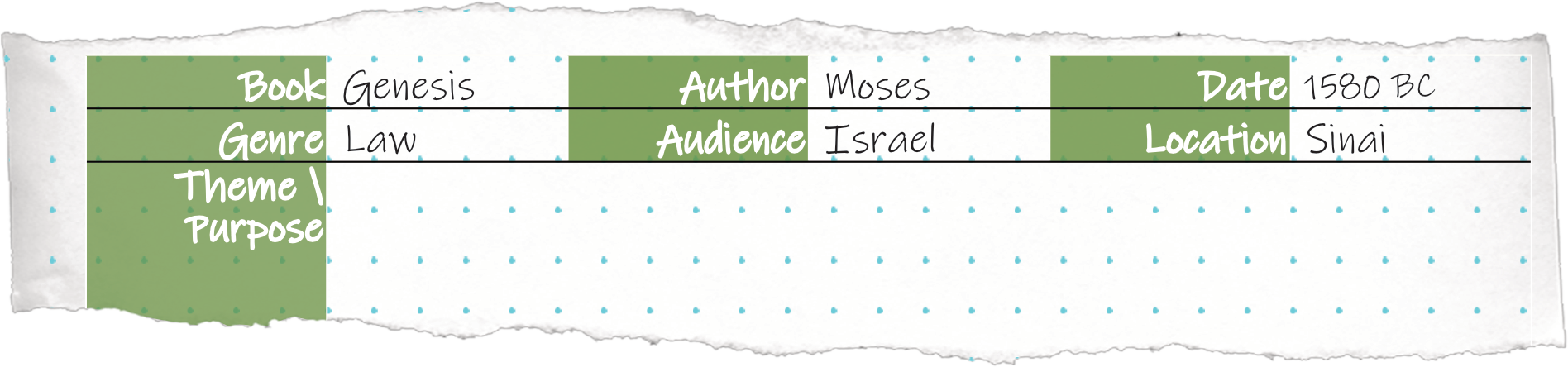
Some of this basic information you may be able to find in each book as you read it otherwise a good study bible or commentary will have this information. To make it easier, at the end of this section there will be two tables, one for the Old Testament and one for the New with this information.

Surveying the Text

Identify

To do a survey you will be concentrating on the setting and keywords which you will mark in brown and God marked in purple. Start by looking for and circling repeated words and their synonyms.  If they match one of the categories depicted in the earlier section, then circle them in that categories color. Why do you start by looking for repeated words? With anything written the author has some ideas or points he wants to communicate to the reader. The terms that describe these points will be repeated as they are exponded upon or will be stressed using repetition. Therefore to grasp the major topics one needs to look for repeated terms and these form the basis for the context of what is written.

As you identify key repeated words make note of the genre if it differs from the book’s general genre. Books of law may also have history and poetry. Identify people, places and things that make up the setting and key events or commands and mark these following the symbols guide below. These might be obvious, but they might not stand out. At this point you can start using inquiry or some simple questions to help identify elements of the setting and circumstances. 

Inquire

In English classes you should have run into the five Ws and a H. While surveying and later when you inspect the text you will need to start asking who, what, when, where, why, and how. While surveying the level of questioning doesn’t need to be as probing as when you are rereading the text during the Inspection phase and you will limit yourself to specific questions focusing on the setting and keywords to just gain a basic understanding of the topic that is being addressed in the chapter. 

Start by asking who are the main characters or groups of characters and are they a protagonist or antagonist? What does God do or what does He command or promise? Marking what he does with a purple double underline and God’s promises with a purple arch and His commands with a green exclamation point and underline. What are the main events? Mark antagonists and protagonists with a brown underline ending in an A or P respectively. If it is a king or kingdom draw a blue crown at the beginning. Mark references to God with a purple triangle or angel of the Lord with a red cross. But only mark these when God is actively at work or responding. If the chapter is just talking about God such as saying “we have sinned against God” then these references do not need to be marked. You only want to call attention to God, Jesus or the Holy Spirit when they are an active character in the chapter so you can see when God is responding. The goal here and and more so during the Inspection phase is to grasp what His feelings are about the circumstances recorded.

Then ask where is this happening or where is the author seeing what he is writing? When is this happening? Underline and mark the location with a blue at sign @ and times with a blue circle with clock hands (/). If the author is writing from a particular vantage point rather than use an at sign start with a semi-encircled v into an (V underline. For example when Moses is describing the creation of the world in Genesis 1 where is he? He is with “(V the Spirit hovering over the waters“. 

The vantage point and use of phenomenal language can be key to understanding what the bible is saying. Phenomenal language is the use of words to describe what you see or feel happening from the perspective of your senses and from your vantage point. We use this every day when we say “the sun rose” or “the sun set”. The sun doesn’t really go up or rise nor does it go down or set. When Moses describes the sky as a firmament he isn’t saying it is a solid dome, he is saying it looks like a dome. If you accept that it must be a dome then you run into the problem of a clash with reality that is not necessary at all. While the bible is not a science text book it does describe things that actually happened and that exist. Whatever may be described more precisely or scientifically should be able to match what the author describes if he were to experience it, the bible does not make mistakes. 

Digest / Summarize
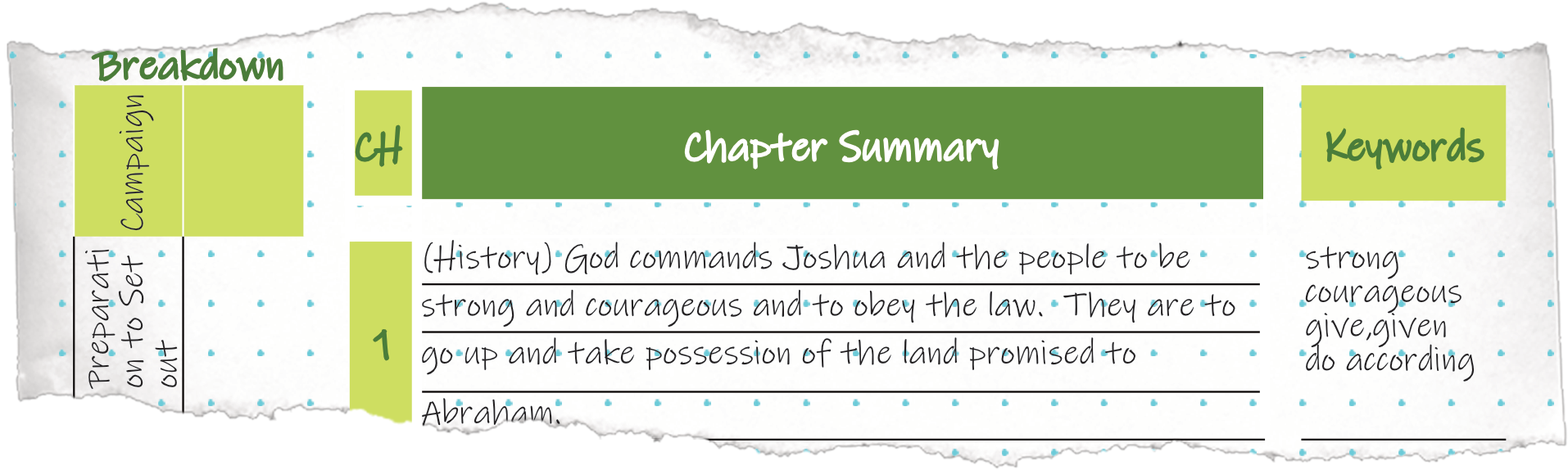
Since this is a survey you don’t want to spend much time asking how and why. If an explanation of how or why is apparent take note of it but we will spend time on this during the inspection phase. After you have read the chapter and marked the obvious keywords and setting record the keywords in the keyword’s column in the survey form and in the margin of your bible. Then write a short one or two sentence summary in the middle summary section of the form. If the genre is different from that of the book record that in parenthesis. 

These summaries and the worksheets will become a reference in the future as you inspect and re-examine a passage in the Bible. It will form the context that limits or qualifies what may be understood. Finally, they will help you better remember what you have read and will develop Biblical Intelligence.

“Perhaps the best test of a man’s intelligence is the capacity for making a summary.” – Lyton Stachey
Then the best exercise to develop biblical intelligence is to practice making summaries.

Roll Up into a Breakdown

In the Bible survey worksheet you have been recording the keywords and summaries. Now it’s time to pull it all together. Consider the keywords column from each chapter and the categories they might fall into. Can you group the keywords in any way? Use the breakdown columns to group the chapters and their keywords into categories. You are rolling up the chapters’ settings and key words into main points of an outline which becomes the breakdown of the book. 

You are looking for relationships between chapters and you will need to do this as part of an end of book review but if you notice a change or turning point or transition while reading don’t hesitate to make note of it using a pencil in the breakdown column so you don’t forget it. To use the breakdown columns you will want to turn the page horizontal and draw lines between these changes you see in categories and then write a short title for that break or segment. Some categories or ways of grouping keywords and circumstances of the setting include:

  • Composition or Literary Devices
    • Pivotal Points / Turning Points
    • Progression and Climax
    • Radiation
  • Others
    • Time / Place / Vantage Point
    • Reigns
    • Topics
    • Doctrines
    • Events / Tasks
    • Signs
    • Goals / Objectives

Finally, in the heading block of the worksheet write a theme and purpose for the entire book. The theme can be thought of as if someone were to ask you “write me a title for that book”. Next write down why you think the book was written and any other notes you feel may be helpful. Now you have completed your survey of the book. You will want to keep these surveys for future reference whenever you come back to study a passage in that particular book of the Bible.

Old Testament Books – Author, Date, Location and Genre

New Testament Books – Author, Date, Location and Genre

Washed in the Word Part 3 – Context

In the past two articles we have talked about significance of the Bible being worthy of our admiration and respect. We talked about how we get in the way of what God wants to tell us because of our attitudes and preconceptions. Setting out to read the Bible these are some of the first things that must be dealt with and finally the last thing is to have integrity when approaching the Bible.

Approach the Bible in Context with Integrity

The word Context means the text that goes with the text. The meaning of words and sentences is dictated or determined considering the surrounding words and sentences. For example, the word cast has two meanings; to toss or to form in a mold but how do we know which meaning is intended by an author. Well, the fisherman casts a net, and the artists casts a statue. We know that fishermen throw nets and lines into the water to catch fish and therefore the meaning is to throw. We know that artists cast bronze into a mold to create a statue, so the meaning is to form in a mold. What the author, God, means to tell us will not contradict the context. There is a saying, “context is king”, because it is the authority that determines the intended meaning.

Now what does this have to do with integrity? If someone has ever taken some words you said and then some other words you said and strung them together falsely accusing you of lying, or slander then you know how upsetting that can be. This is called taking what someone said out of context. Sometimes people do this to make someone who they don’t like look bad. Other times someone might do this not realizing it when they hope someone whose ideas they disagree with would be found saying something that most would not accept and then they would be discredited. Other times someone has an idea that they want to be accepted and they might look for anything a person in authority has said that would back up their idea. You do not want to be found doing the same thing with God’s words.

2 Timothy 2:15 – Be diligent to present yourself approved to God as a workman who does not need to be ashamed accurately handling the word of truth.

Often we just look for some encouraging verses, maybe about God’s promises or exhortations that is inspirational. These can be great resources, but it is like going to a banquet and only eating the hors d’oeuvres but missing the meal. Worse yet sometimes without the verses arround it an encouraging verse or promise may be based on a misunderstanding, in which case it is junk food.

If there is a passage or chapter of the Bible you want to study you must first read the chapter before it and after it as well before you then re-read it to consider it more carefully and more deeply. In fact you should read the whole book, notice I said read not study, not slowly but at a high level looking for the obvious topics and themes. Once you have done this then you can read a chapter or some verses in the Bible slowly and more deeply making sure you have a right understanding directed by what came before and after it.

Approach the Bible using a good Translation

Finally, the text matters. The Bible was written in Hebrew and later Aramaic and then Greek. Then, someone had to take all the various copies throughout history and compare them to compile what is called a text removing typos, and errors; this process is called textual criticism. Then groups of translators come and write a translation of these words into our common language. We have been blessed with several hundred English translations of the Bible but not all are good for study. Someone has even translated the Bible into pirate speech; maybe they were having fun or poking fun at something which deserves to be admired and respected.

Since the original ancient languages are different from our own and even the order of words are different translators have a balancing act between writing what captures the broadest meaning of each word and interpreting multiple words to decide what the original author meant and then to write it in a way we would understand. Often, we look for a Bible translation that says things in the way we like to hear or that supports our own thinking. I notice some recent Christian books jumping between many translations of the Bible and I find myself wondering; were they looking for the translation that presented the most accurate understanding of the verses in the bible or were they looking for a translation that best backed up the idea they had? Our goal should always be to understand what God wants to communicate, not what we hope He will say. Don’t look for a translation that says things the way you like but one that was intended to be as faithful to the original words of God.

In the next article we will spend more time on translations and bible study tools. The picture above shows the various kinds of translations starting with the formal equivalent where the goal is to capture the meaning of each Hebrew or Greek word with minimal interpretation. Then Dynamic equivalents such as functional and natural try to strike a balance between capturing the meaning of each phrase and explaining the meaning in ways that are more familiar to us. Finally, paraphrases are explanations of the meaning of each verse or paragraph in modern English. For reading a Functional Equivalent or Natural Equivalent is sufficient but for intentional study you should use a natural or formal equivalent. I would avoid hyper-paraphrases as they are rewritten from someone’s perspective to such a degree that they should no longer be called a translation. They should really be called poetic commentaries or stores of the Bible and should only be read for reference understanding that they are the thoughts of someone else and may not reflect what God wanted to communicate.

Washed in the Word Part 2 – Objective

In the first part of how to approach the bible we were confronted with the uniqueness and need for God’s word.  Approaching the Bible with admiration and great expectation was all about our affections and motivations. Next, we must face ourselves and be honest about our purpose and attitudes.

Approach the Bible Objectively

When we read the Bible our aim must be true, we must approach it objectively or selflessly, uninfluenced by our feelings or prejudice. Do not look for what you want to find but be open to anything God wants to reveal. Prepare yourself with prayer saying,

“Lord, help me to accept what Your Word says even if I do not like what it says, even if what it says makes me feel uncomfortable. May Your word wash over me and create in me a clean heart and renew a right spirit within me”

Understand is a Matter of desiring or being willing to do God’s Will.

You must have such integrity if you are going to understand what the Bible says. Often when we have trouble understanding the Bible it is not because it is difficult to comprehend but it is hard because we lack the will to do God’s Will. Understanding the Bible starts with having the will to do God’s will; our persistent intent and purpose must be to accept God’s will and to do it. Then Proverbs calls us to treasure knowledge, the next step is to value knowing what God wants to reveal in His Word

John 8: 43 – “Why don’t you understand what I am saying? It is because you cannot accept my teaching.”

John 7:17-18 – “If anyone is willing to do His will, he will know of the teaching, whether it is of God or whether I speak from Myself. He who speaks from himself seeks his own glory; but He who is seeking the glory of the One who sent Him, He is true, and there is no unrighteousness in Him.”

What God wants us to know He tells us clearly in the Bible.

What God wants to tell us, is He not able to make it clear to every generation and people? What He wants to tell us about the future, is He not able to keep is hidden until the time that it is necessary? The Bible was written to an ancient culture, and we may feel like outsiders trying to look into a very different world. But this sense of remoteness, this disconnect is an illusion that comes from trying to connect with the Bible in the wrong place; the character’s time and culture. The link between them and us is not found there. The link is God Himself, because the God they dealt with is the same God we must deal with today. Knowledge of ancient cultures will add to understanding but it will not change the meaning found in a good translation by 180 degrees or even 90 degrees for that matter.

If someone says you need special knowledge to understand the Bible and they claim that they and other experts have that special knowledge, watch out! It is more likely they are wolves trying to manipulate the Bible for their own ends. They have more faith in man’s ideas than God’s teachings.

The Bible is clear and brings clarity, we are the ones that bring the fog of confusion. Out of prejudice we determine what is right and wrong and even presume to judge what God says. Out of desire we look to justify our own actions and ideas even searching God’s word for some small phrase that would seem to make us right.

Luke 10: 25-29 – 25 And behold, a scholar of the Law stood up and was putting Him to the test, saying, “Teacher, what shall I do to inherit eternal life?” 26 And He said to him, “What is written in the Law? How do you read it?” 27 And he answered and said, “You shall love the Lord your God with all your heart, and with all your soul, and with all your strength, and with all your mind; and your neighbor as yourself.” 28 And He said to him, “You have answered correctly; do this and you will live.” 29 But wishing to justify himself, he said to Jesus, “And who is my neighbor?

Do not be like a lawyer looking for the loopholes when you read the Bible. Do not be a politician using it for your own gain. Do not be a religious person trying to show off your list of accomplishments. Come as lowly as you are, as truly needy as you really must be and find waters that never run dry. Find new wine and bread unlike any other. Find freedom and rest for your soul.

2 Timothy 2:15 – 15 Be diligent to present yourself approved to God as a workman who does not need to be ashamed, accurately handling the word of truth.

John 8:31-32 “If you abide in my word, you are truly my disciples, and you will know the truth, and the truth will set you free.”
