Washed in the Word Part 7 – Inspecting Scripture

After surveying a book of the Bible you should now have a good idea of the themes or topics written about in that book. With these topics in mind and the summaries you have written as a foundation for the context you will need you are ready to look more deeply at each chapter. The things to look for and symbols you can use expands at this point to include all those in the symbol guide pictured here. 

Here we will go over the basic method for inspection and interpretation, understanding what you read, and general things to look for. During the survey we limited what we looked for and the questions we asked but here the field is wide open. Look for every category, ask whatever question comes to mind and think deeply. There are more specific things to look for and questions you can ask based upon the genre and literary devices which deserve their own chapters.  We will address those later down the road. 

The Inspection Journal

Rather than dive right into what to look for and the deeper methods of observation and interrogation let us start with the tools and how to use them. During the survey you used some symbols, colored pens and marking guides along with a few basic questions and recorded the key words and summaries in a Survey worksheet. Now you will broaden your marking and observations in the bible and instead of a worksheet it will be a bit freer form using a Journal similar to what Johnathan Edwards called a Miscellanies Journal. If you have a wide margin bible, you could use that space for a journal but even in wide margin bibles space is still limited. 

The 18th Century Pastor and Theologian, Johnathan Edwards, would take a journal and label it with a letter starting with M for Miscellanies. He would reserve the first few pages for an index and then he would date his first entry and label it with M0001 and the Bible reference he was studying, say Joshua 1. In the margins of his Bible for Joshua 1 he would write M0001 to cross reference with the journal and then record his thoughts and questions about the passages as he read it in the journal. He would then list the journal pages along with the label, reference, and theme in the index. With this method he could write as much as he wanted and years later if he were rereading the passage, he could add to the notes with a new journal just referencing it with its letter and sequence number in the Bible’s margin. 

The Inspect process will use this same tool. For a journal I would recommend an A5 (6×8) dotted or lined journal which are easy to find. After I reached 50 writing and reading smaller text became increasingly difficult, so I started using either a letter/A4 size or B5 (7×10) dotted or lined journal. A dotted journal provides free space and guides if you like drawing diagrams or pictures; yes, draw away. As you look more deeply at a passage marking more significant or important words and drawing lines to see relationships you will then start asking questions and thinking about answers. Write these questions and answers and any other thoughts you may have in a journal. Do not feel as if you must answer every question that comes to mind. If some of your questions don’t seem to have answers write them in the journal anyway and leave some space after the question for a future answer. You may also want to use a colored sticky tab to mark the unanswered questions in the journal.  Look back and review your questions and as you move forward reading the Bible you may find answers to those questions at which point you can write the answer and cross reference it with different color ink to where you are in the Bible using that future entry’s label and reference where you find the answer and then toss out the tab.

If you believe God is saying something significant to us, His People, record it as a thesis statement and use a sticky tab to mark it for further verification. You would then take this idea or hypothesis and reexamine them during the examination phase.

Interrogating the Bible Passage

Let’s get back to asking questions. During the survey questions were limited to finding the setting. Now ask any question that comes to mind. To start let’s revisit the five Ws and a H. Asking where and when is what we started with in the survey but is there anything more we could ask about location and time? If the bible is saying something is happening at a certain time or place is it where or when it should happen? An example is Deuteronomy 6 and 11 where God tells the people to talk about His words at home when they sit down, when they rise up and when they travel.

We talked about asking who are the characters involved and identifying God’s involvement. Who is the author and who is it written to or about? The Bible is God’s word written for God’s people but some words were for unbelievers, those that are not God’s people. In these cases the words used and the practices described will fall into that context and usually are ridiculed or contrasted with what is right. Having a clear picture of “who” becomes critical to understanding what God is saying.

Next what is being described or what is happening? Then the follow up question is why. Why did this happen? Why is God calling attention to this? When you are trying to find the reason or cause for something be prepared to ask why more than once. Why did “A” happen? Well because “B” happened. Why did “B” happen? Well because “C” circumstances were encountered. Why were “C” circumstances encountered? Well because “D” decisions were made. You may have to ask why up to five times to get to the root of the matter. 

Finally, ask how. How did they get to this point? How did they do that and why? How important is this or what is its significance?  Is the Bible saying this is how things should be done or is it just how something was done? If it is how things should be done usually God will be involved either showing his approval or giving a command. Otherwise, God will show his disapproval. If God’s point of view is not clear then be careful not to draw a conclusion or pass judgements when God Himself doesn’t do so.

Coming to an Understanding

The answers to the questions you ask form the basis for your understanding of what God wants to say. The practice of understanding the bible is called interpretation. The methods used to understand the Bible are called hermeneutics. As you are asking questions and making observations there are some guidelines you should keep in mind before you draw any conclusions and as you answer questions.

  • It is not advisable to develop a guiding principle or draw a conclusion based on a single obscure verse in the Bible. An example would be Mark 16:18 “they will pick up serpents, and if they drink any deadly poison, it shall not hurt them;”. Another verse is 1 Corinthians 15:29 which says, “what will they do those who are baptized for the dead”. Baptism for the dead is obscure and could have several possible meanings but there are no available ancient manuscripts that help explain this verse.
  • The Bible itself is its best interpreter. As the inspired word of God the bible is consistent and coherent. If some passage doesn’t seem to make sense, is unclear or has many possible meanings, especially if they do not align, the correct meaning is the one supported by other passages in the Bible.
  • Understand historical accounts in the Bible by the teachings in the Bible. For example the letters written by Paul and the other Apostles provide explanations and teachings for the church. That should be used to understand the history recorded in the gospels and Acts.
  • What someone does in the Bible should not necessarily be considered prescriptive; the way we should always do things. Unless it is specifically commanded something done may just be the way someone did something and not necessarily the way we should do something. For example; just because Gideon requested a specific sign from God does not mean that is how we should approach God for direction.
  • It is not advisable to pass judgement on what God’s anointed followers do in a passage of the Bible unless God Himself does so either in the passage or somewhere else explicitly in the Bible. If God judges someone’s actions in the Bible do not add to it. Something may sound wrong but could just be from our own modern sensibilities. For example we tend to look down on arranged marriages but most in the Bible were arranged including the very first marriage between Adam and Eve, arranged by God. 
  • Do not let man’s conclusions, methods or principles dictate what the Bible must mean. If you find yourself saying, “Well, the Bible can’t mean that!” be careful that you are not lifting an idea or theology, a system of man above the Bible.
  • If God tells a specific group or type of person to do something that doesn’t mean the scope is limited to that group or type of person. Just because the letters to Timothy were written to a pastor doesn’t mean we don’t need to read them nor that nothing in them applies to us who are not pastors. Just because God tells fathers to do something with their children doesn’t mean mothers are not to do it as well.
Washed in the Word Part 6 – How to Survey a Book of the Bible

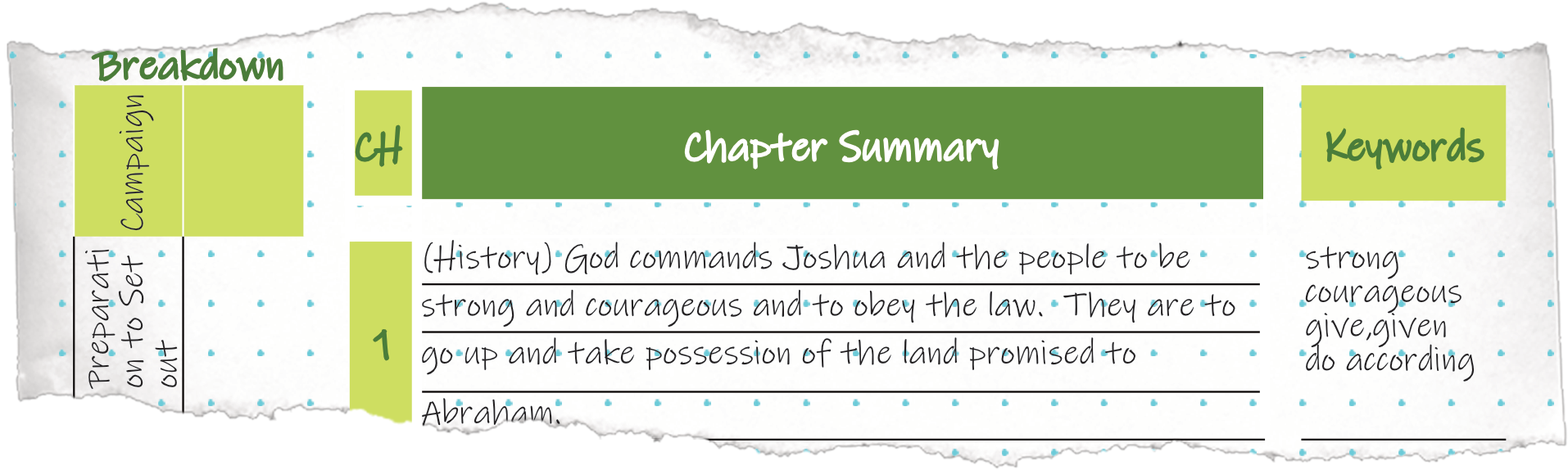
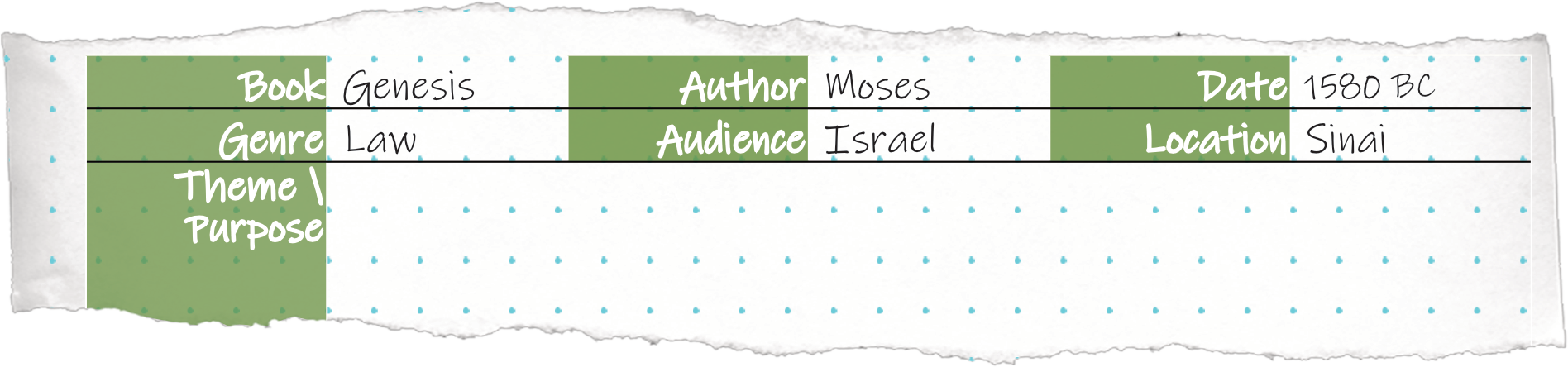
The first goal of the Washed in the Word R.INS.E study method is to Read the book of the bible you are studying chapter by chapter trying to grasp the big picture so that you have a high-level idea of the topics of each chapter. This forms the context that you need to have before you can read any passage in that book of the Bible more deeply. In the survey worksheet the heading of the first page for each book has a form for recording the book name, genre, author, audience, date and location of writing. This is followed by a block section where after reading the book you record its theme and purpose and any other notes or thoughts.

Some of this basic information you may be able to find in each book as you read it otherwise a good study bible or commentary will have this information. To make it easier, at the end of this section there will be two tables, one for the Old Testament and one for the New with this information.

Surveying the Text

Identify

To do a survey you will be concentrating on the setting and keywords which you will mark in brown and God marked in purple. Start by looking for and circling repeated words and their synonyms.  If they match one of the categories depicted in the earlier section, then circle them in that categories color. Why do you start by looking for repeated words? With anything written the author has some ideas or points he wants to communicate to the reader. The terms that describe these points will be repeated as they are exponded upon or will be stressed using repetition. Therefore to grasp the major topics one needs to look for repeated terms and these form the basis for the context of what is written.

As you identify key repeated words make note of the genre if it differs from the book’s general genre. Books of law may also have history and poetry. Identify people, places and things that make up the setting and key events or commands and mark these following the symbols guide below. These might be obvious, but they might not stand out. At this point you can start using inquiry or some simple questions to help identify elements of the setting and circumstances. 

Inquire

In English classes you should have run into the five Ws and a H. While surveying and later when you inspect the text you will need to start asking who, what, when, where, why, and how. While surveying the level of questioning doesn’t need to be as probing as when you are rereading the text during the Inspection phase and you will limit yourself to specific questions focusing on the setting and keywords to just gain a basic understanding of the topic that is being addressed in the chapter. 

Start by asking who are the main characters or groups of characters and are they a protagonist or antagonist? What does God do or what does He command or promise? Marking what he does with a purple double underline and God’s promises with a purple arch and His commands with a green exclamation point and underline. What are the main events? Mark antagonists and protagonists with a brown underline ending in an A or P respectively. If it is a king or kingdom draw a blue crown at the beginning. Mark references to God with a purple triangle or angel of the Lord with a red cross. But only mark these when God is actively at work or responding. If the chapter is just talking about God such as saying “we have sinned against God” then these references do not need to be marked. You only want to call attention to God, Jesus or the Holy Spirit when they are an active character in the chapter so you can see when God is responding. The goal here and and more so during the Inspection phase is to grasp what His feelings are about the circumstances recorded.

Then ask where is this happening or where is the author seeing what he is writing? When is this happening? Underline and mark the location with a blue at sign @ and times with a blue circle with clock hands (/). If the author is writing from a particular vantage point rather than use an at sign start with a semi-encircled v into an (V underline. For example when Moses is describing the creation of the world in Genesis 1 where is he? He is with “(V the Spirit hovering over the waters“. 

The vantage point and use of phenomenal language can be key to understanding what the bible is saying. Phenomenal language is the use of words to describe what you see or feel happening from the perspective of your senses and from your vantage point. We use this every day when we say “the sun rose” or “the sun set”. The sun doesn’t really go up or rise nor does it go down or set. When Moses describes the sky as a firmament he isn’t saying it is a solid dome, he is saying it looks like a dome. If you accept that it must be a dome then you run into the problem of a clash with reality that is not necessary at all. While the bible is not a science text book it does describe things that actually happened and that exist. Whatever may be described more precisely or scientifically should be able to match what the author describes if he were to experience it, the bible does not make mistakes. 

Digest / Summarize

Since this is a survey you don’t want to spend much time asking how and why. If an explanation of how or why is apparent take note of it but we will spend time on this during the inspection phase. After you have read the chapter and marked the obvious keywords and setting record the keywords in the keyword’s column in the survey form and in the margin of your bible. Then write a short one or two sentence summary in the middle summary section of the form. If the genre is different from that of the book record that in parenthesis. 

These summaries and the worksheets will become a reference in the future as you inspect and re-examine a passage in the Bible. It will form the context that limits or qualifies what may be understood. Finally, they will help you better remember what you have read and will develop Biblical Intelligence.

“Perhaps the best test of a man’s intelligence is the capacity for making a summary.” – Lyton Stachey
Then the best exercise to develop biblical intelligence is to practice making summaries.

Roll Up into a Breakdown

In the Bible survey worksheet you have been recording the keywords and summaries. Now it’s time to pull it all together. Consider the keywords column from each chapter and the categories they might fall into. Can you group the keywords in any way? Use the breakdown columns to group the chapters and their keywords into categories. You are rolling up the chapters’ settings and key words into main points of an outline which becomes the breakdown of the book. 

You are looking for relationships between chapters and you will need to do this as part of an end of book review but if you notice a change or turning point or transition while reading don’t hesitate to make note of it using a pencil in the breakdown column so you don’t forget it. To use the breakdown columns you will want to turn the page horizontal and draw lines between these changes you see in categories and then write a short title for that break or segment. Some categories or ways of grouping keywords and circumstances of the setting include:

  • Composition or Literary Devices
    • Pivotal Points / Turning Points
    • Progression and Climax
    • Radiation
  • Others
    • Time / Place / Vantage Point
    • Reigns
    • Topics
    • Doctrines
    • Events / Tasks
    • Signs
    • Goals / Objectives

Finally, in the heading block of the worksheet write a theme and purpose for the entire book. The theme can be thought of as if someone were to ask you “write me a title for that book”. Next write down why you think the book was written and any other notes you feel may be helpful. Now you have completed your survey of the book. You will want to keep these surveys for future reference whenever you come back to study a passage in that particular book of the Bible.

Old Testament Books – Author, Date, Location and Genre

New Testament Books – Author, Date, Location and Genre

Washed in the Word Part 3 – Context

In the past two articles we have talked about significance of the Bible being worthy of our admiration and respect. We talked about how we get in the way of what God wants to tell us because of our attitudes and preconceptions. Setting out to read the Bible these are some of the first things that must be dealt with and finally the last thing is to have integrity when approaching the Bible.

Approach the Bible in Context with Integrity

The word Context means the text that goes with the text. The meaning of words and sentences is dictated or determined considering the surrounding words and sentences. For example, the word cast has two meanings; to toss or to form in a mold but how do we know which meaning is intended by an author. Well, the fisherman casts a net, and the artists casts a statue. We know that fishermen throw nets and lines into the water to catch fish and therefore the meaning is to throw. We know that artists cast bronze into a mold to create a statue, so the meaning is to form in a mold. What the author, God, means to tell us will not contradict the context. There is a saying, “context is king”, because it is the authority that determines the intended meaning.

Now what does this have to do with integrity? If someone has ever taken some words you said and then some other words you said and strung them together falsely accusing you of lying, or slander then you know how upsetting that can be. This is called taking what someone said out of context. Sometimes people do this to make someone who they don’t like look bad. Other times someone might do this not realizing it when they hope someone whose ideas they disagree with would be found saying something that most would not accept and then they would be discredited. Other times someone has an idea that they want to be accepted and they might look for anything a person in authority has said that would back up their idea. You do not want to be found doing the same thing with God’s words.

2 Timothy 2:15 – Be diligent to present yourself approved to God as a workman who does not need to be ashamed accurately handling the word of truth.

Often we just look for some encouraging verses, maybe about God’s promises or exhortations that is inspirational. These can be great resources, but it is like going to a banquet and only eating the hors d’oeuvres but missing the meal. Worse yet sometimes without the verses arround it an encouraging verse or promise may be based on a misunderstanding, in which case it is junk food.

If there is a passage or chapter of the Bible you want to study you must first read the chapter before it and after it as well before you then re-read it to consider it more carefully and more deeply. In fact you should read the whole book, notice I said read not study, not slowly but at a high level looking for the obvious topics and themes. Once you have done this then you can read a chapter or some verses in the Bible slowly and more deeply making sure you have a right understanding directed by what came before and after it.

Approach the Bible using a good Translation

Finally, the text matters. The Bible was written in Hebrew and later Aramaic and then Greek. Then, someone had to take all the various copies throughout history and compare them to compile what is called a text removing typos, and errors; this process is called textual criticism. Then groups of translators come and write a translation of these words into our common language. We have been blessed with several hundred English translations of the Bible but not all are good for study. Someone has even translated the Bible into pirate speech; maybe they were having fun or poking fun at something which deserves to be admired and respected.

Since the original ancient languages are different from our own and even the order of words are different translators have a balancing act between writing what captures the broadest meaning of each word and interpreting multiple words to decide what the original author meant and then to write it in a way we would understand. Often, we look for a Bible translation that says things in the way we like to hear or that supports our own thinking. I notice some recent Christian books jumping between many translations of the Bible and I find myself wondering; were they looking for the translation that presented the most accurate understanding of the verses in the bible or were they looking for a translation that best backed up the idea they had? Our goal should always be to understand what God wants to communicate, not what we hope He will say. Don’t look for a translation that says things the way you like but one that was intended to be as faithful to the original words of God.

In the next article we will spend more time on translations and bible study tools. The picture above shows the various kinds of translations starting with the formal equivalent where the goal is to capture the meaning of each Hebrew or Greek word with minimal interpretation. Then Dynamic equivalents such as functional and natural try to strike a balance between capturing the meaning of each phrase and explaining the meaning in ways that are more familiar to us. Finally, paraphrases are explanations of the meaning of each verse or paragraph in modern English. For reading a Functional Equivalent or Natural Equivalent is sufficient but for intentional study you should use a natural or formal equivalent. I would avoid hyper-paraphrases as they are rewritten from someone’s perspective to such a degree that they should no longer be called a translation. They should really be called poetic commentaries or stores of the Bible and should only be read for reference understanding that they are the thoughts of someone else and may not reflect what God wanted to communicate.

Washed in the Word Part 2 – Objective

In the first part of how to approach the bible we were confronted with the uniqueness and need for God’s word.  Approaching the Bible with admiration and great expectation was all about our affections and motivations. Next, we must face ourselves and be honest about our purpose and attitudes.

Approach the Bible Objectively

When we read the Bible our aim must be true, we must approach it objectively or selflessly, uninfluenced by our feelings or prejudice. Do not look for what you want to find but be open to anything God wants to reveal. Prepare yourself with prayer saying,

“Lord, help me to accept what Your Word says even if I do not like what it says, even if what it says makes me feel uncomfortable. May Your word wash over me and create in me a clean heart and renew a right spirit within me”

Understand is a Matter of desiring or being willing to do God’s Will.

You must have such integrity if you are going to understand what the Bible says. Often when we have trouble understanding the Bible it is not because it is difficult to comprehend but it is hard because we lack the will to do God’s Will. Understanding the Bible starts with having the will to do God’s will; our persistent intent and purpose must be to accept God’s will and to do it. Then Proverbs calls us to treasure knowledge, the next step is to value knowing what God wants to reveal in His Word

John 8: 43 – “Why don’t you understand what I am saying? It is because you cannot accept my teaching.”

John 7:17-18 – “If anyone is willing to do His will, he will know of the teaching, whether it is of God or whether I speak from Myself. He who speaks from himself seeks his own glory; but He who is seeking the glory of the One who sent Him, He is true, and there is no unrighteousness in Him.”

What God wants us to know He tells us clearly in the Bible.

What God wants to tell us, is He not able to make it clear to every generation and people? What He wants to tell us about the future, is He not able to keep is hidden until the time that it is necessary? The Bible was written to an ancient culture, and we may feel like outsiders trying to look into a very different world. But this sense of remoteness, this disconnect is an illusion that comes from trying to connect with the Bible in the wrong place; the character’s time and culture. The link between them and us is not found there. The link is God Himself, because the God they dealt with is the same God we must deal with today. Knowledge of ancient cultures will add to understanding but it will not change the meaning found in a good translation by 180 degrees or even 90 degrees for that matter.

If someone says you need special knowledge to understand the Bible and they claim that they and other experts have that special knowledge, watch out! It is more likely they are wolves trying to manipulate the Bible for their own ends. They have more faith in man’s ideas than God’s teachings.

The Bible is clear and brings clarity, we are the ones that bring the fog of confusion. Out of prejudice we determine what is right and wrong and even presume to judge what God says. Out of desire we look to justify our own actions and ideas even searching God’s word for some small phrase that would seem to make us right.

Luke 10: 25-29 – 25 And behold, a scholar of the Law stood up and was putting Him to the test, saying, “Teacher, what shall I do to inherit eternal life?” 26 And He said to him, “What is written in the Law? How do you read it?” 27 And he answered and said, “You shall love the Lord your God with all your heart, and with all your soul, and with all your strength, and with all your mind; and your neighbor as yourself.” 28 And He said to him, “You have answered correctly; do this and you will live.” 29 But wishing to justify himself, he said to Jesus, “And who is my neighbor?

Do not be like a lawyer looking for the loopholes when you read the Bible. Do not be a politician using it for your own gain. Do not be a religious person trying to show off your list of accomplishments. Come as lowly as you are, as truly needy as you really must be and find waters that never run dry. Find new wine and bread unlike any other. Find freedom and rest for your soul.

2 Timothy 2:15 – 15 Be diligent to present yourself approved to God as a workman who does not need to be ashamed, accurately handling the word of truth.

John 8:31-32 “If you abide in my word, you are truly my disciples, and you will know the truth, and the truth will set you free.”

Bible Study Advanced – Key Word Study

Interlinear Bible

As you read through the bible you will want to start looking more deeply at passages to get all the meaning out of them. This is called studying as opposed to just reading through the bible. There are several methods and we had previously discussed a cross-reference study. Another type of study is a Key Word study. The purpose is to get a broader sense of what the words meant to the culture and people in the bible and to check if the word chosen by the translator is the closest definition to what the verse is trying to say, to the context of the words in the verse. When we use a word we are aware of the connotations and possible meanings a word may have from our language but these may not be the same as the word in the Bible in its original language. A key word study is necessary to get the best picture of the thoughts that came to mind when the original author wrote the passage.

As you study a passage look for repeated words, lists or words that are critical to what the text is saying. Then look these words up in a lexicon such as the Strong’s concordance, or those available in bible software such as Logos or BibleWorks or free programs such as The Word (www.theword.net) or online at sights such as new.studylight.org. Another tool is the Interlinear Scripture Analyzer from www.scripture4all.org.   If you have an Interlinear or key word study bible it will list Strong’s numbers above each word that can be used to look up the original Hebrew or Greek word behind the word translated into English. The next step in a key word study is to note the definitions which are the possible denotations the word might have when used in a sentence. It should also be understood that the etymology and consideration of all denotations forms a picture of the sense of connotation which use of the word would also entail.  (An example of connotation would be when I say something is superior instead of saying it is best there is a sense of arrogance with the term superior.)  Record the generic sense that you get from the word whether it has a positive or negative sense or a superior sense. As you look at the references and note the uses of the word this will also build a sense of what connotations the word carried.

Further consideration of the uses of the word in the Bible should establish its most common use or common definition or denotation. Then examples of use should be explored by looking for categories in which the immediate context might be placed that describe types of qualifications that determine the most likely definition or the most correct denotation. From a site like new.studylight.org you can look up a key word and then list its uses either by translation or book of the bible. You may then drill down by translation and get a set of example verses. Looking at how the word is used in these verses. For nouns consider the verbs or actions they take and for verbs consider the subjects and objects.  The Interlinear Scripture Analyzer groups references down to word form and morphology and translation allowing for even greater consideration of the context and translation relative to the meaning of the word.  This may also be accomplished using bible study software and either the search interface or through concordance modules.  Determine if you can categorize these surrounding words into more generic descriptive concepts and record these generic concepts next to the lexicon definition in a table similar to the one inserted below. These generic concepts and categories form the qualifications that can help to determine the most appropriate denotation for a word within the verse you are looking at or considering.  Compare the context of the verses you are exploring and then determine which categories the context most closely aligns to; from this the appropriate translation might be verified.  The assumption is that most of the other translations of the word will likely be accurate.  If a translation may be off it will likely stick out like the proverbial sore thumb as its context (the types of other words around it) will differ from most other examples.

For example re’shiyth can mean first or beginning. In the cases where it generally means first it is part of the object and modifies what is produced so the category would be it qualifies something produced. Whereas when it generally means beginning it modifies an action or role. Then looking for these qualifications the chosen translation of the word in a sentence may be validated considering both its common use and categorization of the immediate context.   The goal shouldn’t necessarily be to the level of textual criticism necessary for translation but to clarify the intended meaning and gain understanding of the broader connotation of a few key words. There are many great online tools as well as bible software programs that may be used to look up key words. For this article the strong’s entries and passage lists can be found at Blue Letter Bible (www.blb.org[1]) and the lexicon at new.studylight.org.

Strong’s H8414

Transliteration

תֹּהוּ

tohuw

Pronunciation

Root Word

‘·

from an unused root meaning to lie waste

N,M

Definition

Uses

Contextual Category

1. formlessness, confusion, unreality, emptiness

a.formlessness (of primeval earth)

2

1.nothingness, empty space

3

State of being relative to the earth and/or sky

b.that which is empty or unreal (of idols)

3

State of being relative to idols

c.wasteland, wilderness (of solitary
places), desolation

6

As an object relative to a location or direction
of travel

d.place of chaos

2

e.vanity, futile, meaningless

6

As the state or end result of earthly authority

Connotation: either body or soul cannot survive here. A place that is or brings about non-existence.

Passages

Gen 1:2

The earth was formless8414and void, and darkness was over the surface of the deep,
and the Spirit of God was moving over the surface of the waters.

Deu 32:10

“He found him in a desert land, And in the howling waste8414of a wilderness; He encircled him,
He cared for him, He guarded him as the pupil of His eye.

1Sa 12:21

“You must not turn aside, for then you would go after futile8414things8414which cannot
profit or deliver, because they are futile.8414

Job 6:18

“The paths of their course wind along, They goup into nothing8414and perish.

Then read through the passage again with the fuller understanding of the depth of meaning behind the key words you have studied. Another way to explain it is to compare the New American Standard translation to the Amplified Bible. In the Amplified translation Mrs Francis Siewert with the Lockman foundation took the American Standard translation along with several key word study references and did to an extent what we have described in this article. Determining the breath of meaning and connotation certain key words might have Mrs Siewert added information on connotations in parenthesis and expanded the translations of other words. Examine the example passage bellow and note the two underlined words in the NASB and how they were expanded in the AMP.
1 Corinthians 2: 14-15 NASB 14But a natural man does not accept the things of the Spirit of God, for they are foolishness to him; and he cannot understand them, because they are spiritually appraised. 15But he who is spiritual appraises all things, yet he himself is appraised by no one.

1 Corinthias 2:14-15 AMP 14 But the natural, nonspiritual man does not accept or welcome or admit into his heart the gifts and teachings and revelations of the Spirit of God, for they are folly (meaningless nonsense) to him; and he is incapable of knowing them [of progressively recognizing, understanding, and becoming better acquainted with them] because they are spiritually discerned and estimated and appreciated. 15 But the spiritual man tries all things [he examines, investigates, inquires into, questions, and discerns all things], yet is himself to be put on trial and judged by no one [he can read the meaning of everything, but no one can properly discern or appraise or get an insight into him].

You may ask “If the AMP does this expansion then why would I want to do a key word study”? Well the AMP doesn’t expand upon every word and well, you should want to verify for yourself if the expansions of meaning done by the AMP makes sense. But reading the AMP can give you a sense of how much more you can see in a verse if you look more deeply at what a word meant and what other meanings it carried.

More advanced lexicons used by students of Greek and Hebrew aren’t based upon Strong’s numbers but function more like a dictionary.  This requires knowledge of the Greek or Hebrew alphabet and looking up words like one would in a common English dictionary.  However there are some tools for Greek that can allow us to take advantage of these resources.  The Study Light (new.studylight.org) or Blue Letter Bible (www.blb.org) provide interlinear bibles from which the Greek word may be copied into your clip board.  The word may then be pasted into the Perseus Digital Libraries (http://www.perseus.tufts.edu/hopper/search) search engine using the Word Study Tool on the right side of the page.  This resource provides access to lexicons such as the LSJ, Liddell and others.  These resources provide more in-depth definitions and other examples of uses of the word through out history and in other literary works.  Additionally more advanced keyword studies would include consideration of word forms with in the verse you are reading. Word forms include noun plurality and gender and verb tense/aspect, voice and mood. Such considerations place further limits on the meaning and scope or depth of what is being talked about. But this is a topic for further discussion in another article.


[1] Blue Letter Bible. “Dictionary and Word Search for tohuw (Strong’s 8414)“. Blue Letter Bible. 1996-2011. 27 Jul 2011.

Bible Study – Cross Reference (FACTS of Study)

As you progress in your study of scripture you will want to take passages and drill down further into what else the bible has to say on the subject and relative to the statements made within each verse. As indicated in the previous article if you are reading through the bible and memorizing scripture as you start to meditate on a particular set of verses, a passage, other statements from the Bible will come to mind setting limits and expanding the concept. But since most of us don’t have the entire bible memorized we can use some help. Some helpful tools are a good cross reference and a topical reference which may be used in a cross reference study.

The purpose of a cross reference study is to in a sense put a “face” to what has been written. To better understand what an author is saying we need to establish the foundation from which the author writes; who they are and how they view the world. Then as we look at what an author says we want to verify our understanding by looking for other statements made by the author that affirm the understanding we get from a particular statement they make. Next we look for clarification or further details that might fill in gaps in our understanding of what the author is trying to communicate. Finally we gather these ideas together, resolve differences in our understanding or expand that understanding to form a better more complete understanding. Let’s call this the FACTS of Bible Study.

  • Foundation – Gather other biblical references regarding the nature of the author, gather other references and external resource information about the context or setting of the text and the characters or subject being written about. Use Cross Reference tools, Commentaries and Topical Tools such as found on the Bible Hub or Open Bible and insights from your own bible reading.
  • Affirmation – Take the gathered references and resources and categorize restatements in support of statements made in the text being studied as affirmations.
  • Clarification – No scripture contradicts another passage but offers clarification. Clarifications can either be qualifications limiting the scope of meaning or application or an expansion of the meaning or scope. Take the gathered references and resources and categorize Statements on the same topic or point that add more detail or clarity to a particular situation as either a qualification or expansion. If the cross references deny anything it will be our flawed understanding of a passage, in which case such a denial is a type of qualification.
  • Thesis – Formulate a basic statement of your understanding of the passage being studied. Gather the facts; context, cross references, restatements and clarifications.
  • Synthesis – combine these points into a more complete understanding resolving issues and expanding the picture the bible is painting. Formulate a thesis; dissertation or summary on the text being studied.

A cross reference study endeavors to be fair to the author by avoiding the traps of taking statements out of context or jumping to conclusions about what the author is saying. One statement does not address all aspects of an issue and it is not fair to an author, in our case God, to assume that it does. One passage of scripture is generally not enough to form a consistent theology.

Any good study bible will have cross references either in the margin or the center column. Cross references are also available in the Treasury of Scripture Knowledge, TSK, available in desk reference form or on such sites as www.blb.org and www.studylight.org. Another option is the open bible website which has a topical and a cross reference database which brings together several different sources providing 340,000 cross references. The cross references are color coded by the degree to which they are similar to the original reference.

http://www.openbible.info/labs/cross-references/

Foundation References

The first thing to show is the nature of the characters the first of which is God and the bible. The table inserted below gives some key passages establishing the nature of God and the Bible.

Natures Reference
Nature of God 1 John 1:5 ESV – This is the message we have heard from him and proclaim to you, that God is light, and in him is no darkness at all.
James 1:17 ESV – Every good gift and every perfect gift is from above, coming down from the Father of lights with whom there is no variation or shadow due to change.
Psalm 90:2 ESV – Before the mountains were brought forth, or ever you had formed the earth and the world, from everlasting to everlasting you are God.
John 4:24 ESV – God is spirit, and those who worship him must worship in spirit and truth.”
Colossians 1:17 ESV – And He is before all things, and in Him all things hold together.
Romans 1:19-20 ESV – 19 For what can be known about God is plain to them, because God has shown it to them. 20 For his invisible attributes, namely, his eternal power and divine nature, have been clearly perceived, ever since the creation of the world, in the things that have been made. So they are without excuse.
Nature of Scripture John 17:17 ESV – Sanctify them in the truth; your word is truth.
2 Timothy 3:16 ESV – All Scripture is breathed out by God and profitable for teaching, for reproof, for correction, and for training in righteousness,
Hebrews 4:12 ESV – For the word of God is living and active, sharper than any two-edged sword, piercing to the division of soul and of spirit, of joints and of marrow, and discerning the thoughts and intentions of the heart.

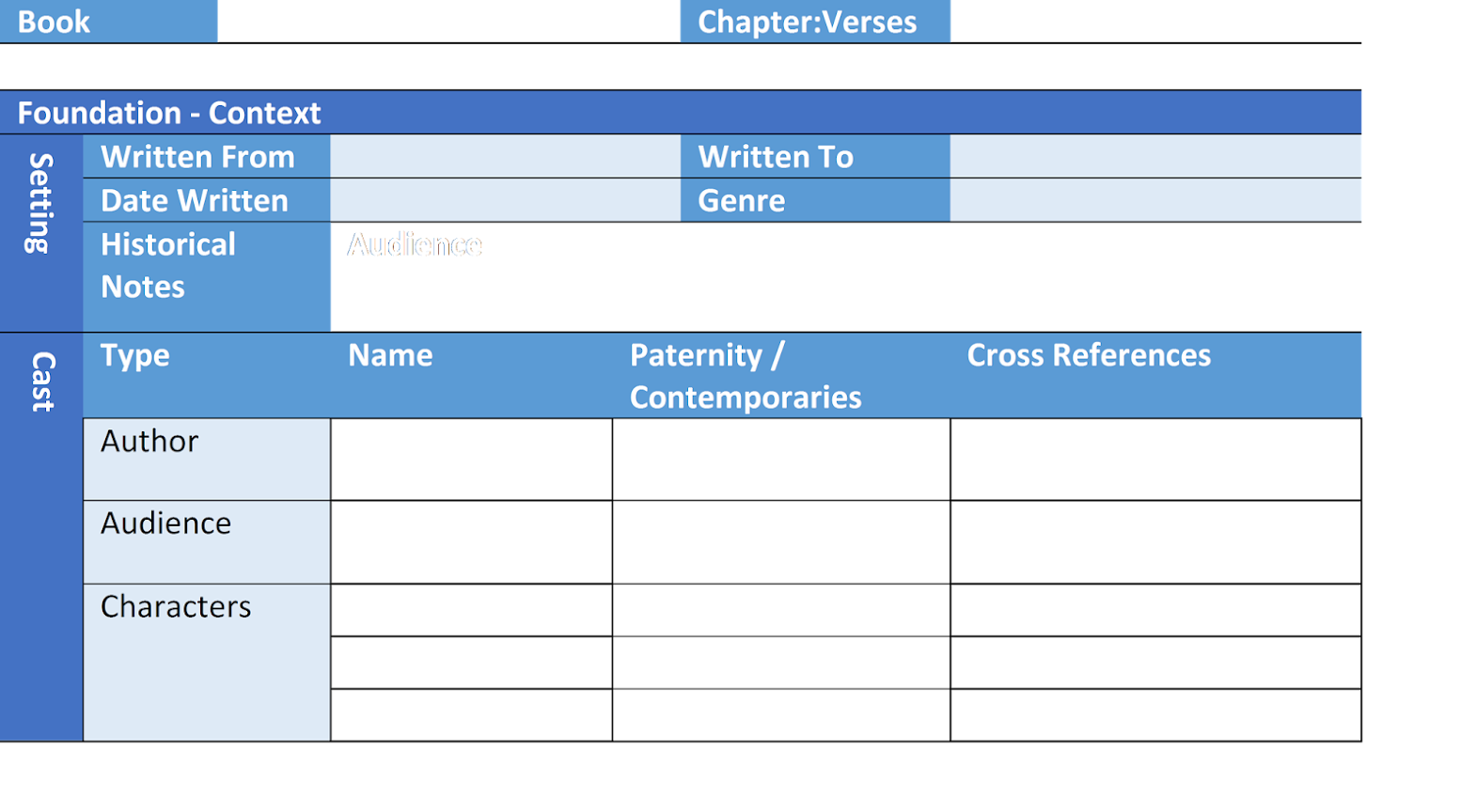
Next gather information on the book of the bible and the passage being addressed. Then determine who was the author being lead by the Spirit and use a topical reference to search for verses about the author and note them. Identify the place and who is being written to and what is being written about and look these up in a topical reference and note them in a table similar to the one below. Gather this information on the date, place of writing, genre (Gospel, Law, History, Psalms, Poetry, Prophecy, or Epistle) and any other historical notes. Gather information on the audience that would have been reading the book written. Finally gather information on any of the characters mentioned in the passage; including their genealogy or any contemporaries related to them and also gather any other biblical references to the characters.

Cross Reference Context Table

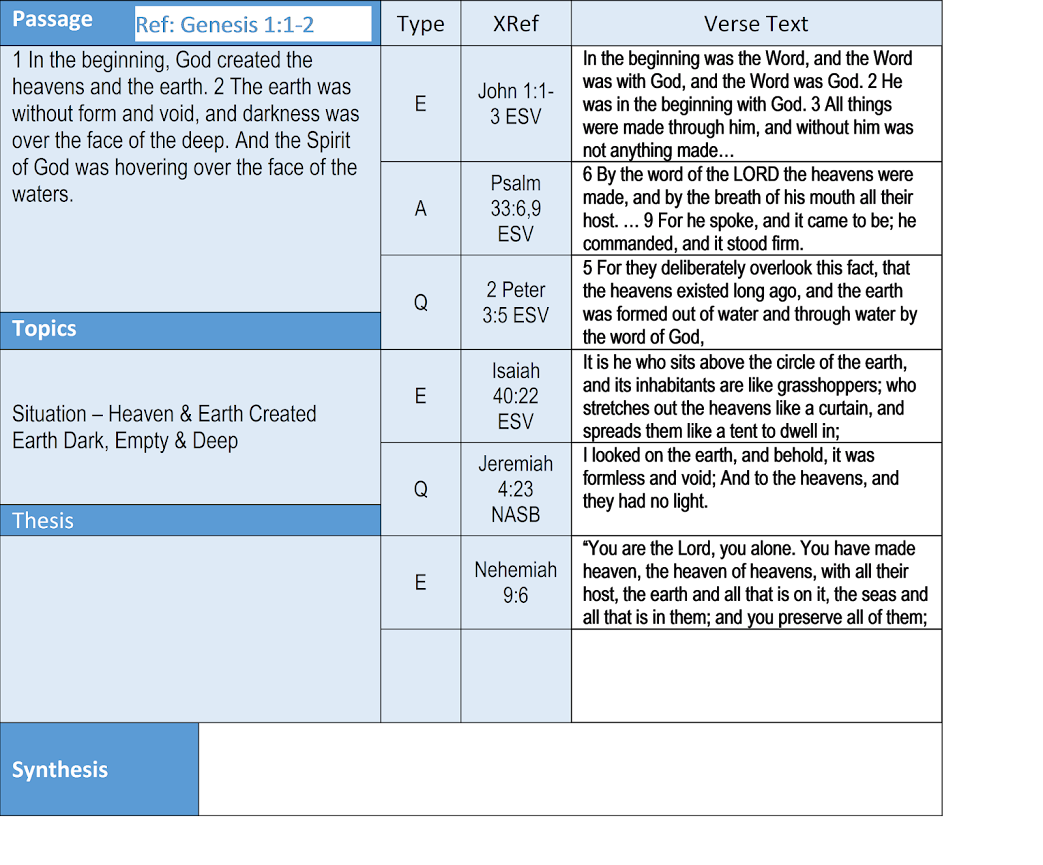
Next break the passage down into sets of verses if possible or address each verse on its own. Gather cross references from some of the resources listed such as the Open Bible, Bible Hub, Study Light or your own study bibles cross references located in the center column or margins. Also look at the introductions to the book and commentaries on the passages and gather these other references. Identify topics or major ideas presented in the text and use a Topical Bible to find additional passages which correspond to the passage you are studying.

Affirmation and Clarification References

Once you’ve gathered the references and verses which correspond to the passage your are studying now you need to categorize them. Remember that other passages of scripture hold greater authority than commentaries, introductions, historical context and other peripheral information. Determine if the reference is either supporting the understanding of the verse or if it is adding more detail to what the verse is talking about and note these separately. A four column table having the reference, topic or key words, Type(A/Q/E/D) and a cross reference column can be used to capture these verses. An example is inserted below. The types are (A)ffirm, (Q)ualify, (E)xpand, and (D)eny remembering that the denial is not of the passage itself but of our understanding of the passage summarized in the thesis (usually due to lack of understanding of the context) or it may be a qualification under a certain set of circumstances..

Cross Reference Synthesis Table

Remember, No scripture contradicts another passage but offers clarification usually on specific situations. If a contradiction seems apparent then the issue may be that the concept or topic being studied has been reduced to a single whole when it needs to be expanded into constituent parts. This probably sounds difficult but our minds tend to group things that are related or similar into simpler singular concepts so we can remember them better. As an example there are many that struggle with the law as presented in the old testament versus the new testament yet in the new testament it states that the law shall not pass away and Jesus said that he didn’t come to abolish the law. But these two testaments seem so different to many of us. In this case we are considering the law as a whole but if we consider that the law is made up of two parts it becomes easier to understand. The law is made up of the imperative or principal and secondly of the prescription or prescribed penalty in the event that the imperative is not followed. Additionally the law falls into three categories of application. There is the Moral law which are the absolute principles which are based upon God’s created and intended purposes. Then there is the Ceremonial law and the Civil law which are protocols for specific situations; some of which may no longer exist so we have to look for the laws intention and translate it to the present circumstances. Some Civil laws for example divorce are protocols which God allowed in accordance with His permissive will because of our hard hearts and struggles in a fallen world but which are not in line with His perfect will or created purpose.

When Jesus stood by the woman caught in adultery and said “he who is without sin cast the first stone” he wasn’t changing the law, he wasn’t saying that adultery really isn’t that big of a deal. He told the woman go and sin no more so the imperative still stands its just the sentencing may vary based upon the circumstances. Deuteronomy has been accused of being quite harsh and it does seem so in many verses however one has to understand that Deuteronomy 6 stated that the prescribed penalties were to be enforced on Israel as they entered the promised land as the chosen people through whom the Messiah would come. They were to be held to a higher enforced standard. Additionally the climate around them was comprised of nations that burned babies in furnaces as human sacrifices to Molech and who practiced temple prostitution, pedophilia, witch craft and other evil practices. So Israel was called to be God’s hand of judgement on these preceding nations who had corrupted the land. This is just one example where we have to look more closely when we think we see a contradiction.

Theses and Synthesis

Read each verse and its related references you have gathered and formulate specific statements about what the verse itself is saying. Formulate other statements about what else the bible has to say on the same topic your verse or set of verses is addressing based on the cross references. Look at extra-biblical references such as historical narratives of the times the verses were written in and commentaries and write down statements about the what was going on at the time the passage was written. Also write statements referencing commentaries.

Finally, read through the cross references you have gathered and your summary statements (Theses). Then reread the passage and consider if what you believe a verse is saying is supported by the cross references gathered or if it is denied. Also as you read passages the combination of specific meaning or denotations form the explicit meaning of the verse but words and phrases also have connotations which lead to possible implied or implicit meanings. The implied meanings sometimes have significant implications and affects as connotations tend to hit us at a spiritual level but there is also the greatest danger for seeing a meaning which the Bible does not intend to convey. It is the cross references which can help validate implicit thoughts from a bible passage and either establish them or exclude them from our mind as we read and try hard to understand God’s word. Then synthesize the information gathered into a thesis summarizing what the verses you are studying say and what else the bible has to say on the topics addressed in the passage. Write down what you have learned from the passage and what the implications for your life which come from your new understanding of the bible passage your are studying.

Cross Reference Tools

Printable Cross Reference Template

Bible_Study_Cross_Reference_Worksheet-print

Word Document Cross Reference Template

Bible_Study_Cross_Reference_Worksheet

Bible Study Basics – ACTS of Study

Consider with me Daniel who was taken into exile in Babylon, away from his country and his family. Daily he prays to God and then we see this, the angel Gabriel comes to him and says:

Daniel 9:23 At the beginning of your pleas for mercy a word went out, and I have come to tell it to you, for you are greatly loved. Therefore consider the word and understand the vision.

God shows His love for Daniel by sending an angel, Gabrel, to explain his visions. God is saying “I’m letting you in on my plans” some of which he is allowed to write down and others are just for him to hear, words given to him in confidence from God. I sat there and it floored me. God is sharing his deepest plans with Daniel, why… Because you are greatly loved I have come to tell you… Just as Daniel got to hear God’s heart, his desires and feelings, and his plans 40 authors over 2000 years inspired by God were sent to tell you, to let you in on God’s heart and plans, why? For you are greatly loved… Every statement in the bible is packed with power and meaning. I don’t need courage I’ve got something greater when I have His word in my hand. Studying the Bible is every Christian’s privilege and duty.

Read more of this post

In Danger of Being Non-Contenders

Rabbi Boruch Ber Leibowitz with his students

Image via Wikipedia

Have We Really Progressed So Much

We proudly look at our home libraries, computers, ebooks and internet and assume that we have progressed so much. But could there be another possibility? The ancient cultures of the bible had a strong oral tradition. What has amazed anthropologists when they analyze recorded oral records is the accuracy with which the accounts have been passed down over centuries. In many cases it is close to the level of transcription errors by scribes of written works.

By age 12 a Jewish boy would have at least the first five books of the bible memorized and in the next five years many would memorize the entire Old Testament. The problem is you don’t know what you don’t know and unless we can associate things with terms to search for we really can’t search these electronic tools necessarily for concepts or examples of such concepts. When Jude calls us to contend for the faith once handed down to us we are actually in greater danger now. We do not have such an oral tradition where the words of the Bible might come to mind when confronted with new ideas or perspectives. What comes to our mind is a limited set of scriptures that we have personally identified with and that match our view of the world. Most of us do not have the pallet of Biblical verses that a 12 year old Jewish boy would have.

When God created man and called His creation good, was Adam then less developed then we are? Did a primitive prehistoric cave man make a willful, sinful choice that condemned us all? Or did God create man with great capacity to understand? We know that necessity is the mother of invention. Could it be that we have digressed instead of progressed? Could it be that maybe we need more crutches like laptops and the internet because our capacities have diminished?

How Can We Progress

Through out John Jesus says I tell you the truth, over and over. The Bible calls us to seek knowledge and when the bible says I tell you the truth then it implies that we can know it and when the Bible says this is hidden until the end then it implies that we can’t know it. John 7:17 tells us that our problem with knowing is not that what the bible tells us is hard to comprehend, our problem with knowing is that we lack the will to do God’s will. Understanding the Bible starts with having the will to do God’s will. Then Proverbs calls us to treasure knowledge, the next step is to value knowing what God wants to reveal in His will.  Thirdly we have to read and memorize God’s word.

John 7:17 If anyone’s will is to do God’s will, he will know whether the teaching is from God or whether I am speaking on my own authority.

We cannot know all of God almighty but we can know what He chooses to reveal to us and what the Spirit will make real to us if we are in His will in our current circumstance as we face the world being a Child of God under the Lordship of Christ.